


Tooth loss remains a prevalent oral health issue in the United States, affecting millions of Americans and driving demand for restorative solutions. From young adults losing a single molar to senior citizens coping with complete tooth loss, the scope of the problem is vast.
National surveys indicate that well over 100 million Americans are missing at least one tooth, and several tens of millions have none of their natural teeth left.
This guide explores the rates of tooth loss and dental extractions nationally and in Northwest Indiana, examines the common causes and risk factors, and discusses how these trends are fueling a growing demand for dental implants.
We’ll look at historical data from 2015–2025 and consider what to expect in 2026, with a focus on the unique regional insights from areas like Lake County, Hammond, Gary, and Valparaiso in Indiana.
Tooth Loss in America: How Prevalent Is It?
Tooth loss is surprisingly widespread in the U.S. and varies by age. In fact, by middle age, it’s common to have had a tooth extracted due to decay, gum disease, or injury. Over recent years, public health improvements have reduced the rate of total tooth loss among older Americans, but the numbers are still significant.
As of 2020, roughly 13% of U.S. adults aged 65 and older had lost all of their natural teeth, down from about 16% in 2012. This downward trend is encouraging, reflecting better dental care and prevention.
However, complete tooth loss still affects many older adults: about 11–12% of adults aged 65–74 are edentulous, and that rate increases to nearly 20% among those aged 75 and older.
Partial tooth loss is far more common. By age 50, the average American has lost several teeth; many in this age group have only 22–23 remaining of the 28 permanent teeth (not counting wisdom teeth).
It’s estimated that around 178 million Americans are missing at least one tooth. In practical terms, that could be as simple as a single molar extraction, but it also includes people with multiple gaps in their smile.
A substantial subset of adults,roughly 10% of 18–64 year-olds nationwide, have lost six or more teeth due to dental disease, a figure that climbs higher in older age brackets.
These national figures underscore that tooth loss is not just an isolated issue affecting a few; it is a common experience. The good news is that complete tooth loss among seniors has been declining over the decades.
In the early 1970s, it was normal for nearly half of Americans over 65 to have no teeth at all, whereas today that figure is closer to one in seven.
Still, millions of Americans enter each year over the age of 60 with significant tooth loss, and as the baby boomer generation has reached retirement age (with generally better dental health than prior generations), they carry with them a lifetime of dental work, some failing restorations, and in many cases, missing teeth that need replacement.
Common Causes of Tooth Loss and Extractions
Why do people lose teeth? In the U.S., the overwhelming majority of adult tooth extractions stem from two dental diseases: tooth decay and periodontal disease. These two causes account for most tooth loss cases:

- Tooth Decay (Cavities): Advanced dental caries can severely damage the structure of a tooth. When a cavity is untreated or too extensive, it can lead to infection or tooth breakage. Decay is often cited as the single leading cause of extractions.
Especially in younger adults, a deep cavity or abscessed tooth is a primary reason a tooth might be pulled. Despite modern dentistry’s ability to fill or crown decayed teeth, many people delay care until decay causes irreparable harm.
Studies show that dental caries is a leading cause of tooth extraction, responsible for roughly one-third to more than half of teethremoved in many populations, indicating that untreated cavities remain a major reason teeth become non-restorable. - Gum (Periodontal) Disease: Gum disease is an equally important culprit, particularly for older adults. Chronic periodontitis can erode the bone and soft tissue that hold teeth in place. Over time, teeth become loose and may eventually need extraction if the disease cannot be controlled.
Periodontal disease tends to be a cumulative effect of years of poor gum health; it’s a leading cause of tooth loss in people over 40. Estimates often attribute roughly one-third or more of tooth extractions to gum disease. In severe gum disease cases, multiple teeth may be lost around the same time, dramatically affecting an individual’s dentition. - Trauma and Injury: Accidents and injuries account for a smaller portion of tooth loss. A sudden impact (from sports, falls, or other accidents) can crack or knock out teeth. Traumatic tooth loss can happen at any age and often involves front teeth or molars depending on the incident.
While less common than disease-related causes, trauma can be significant, especially in younger individuals or in specific scenarios (e.g. vehicle accidents). Modern emergency dentistry sometimes can save a traumatically injured tooth, but not in all cases. - Other Causes: There are several additional reasons that teeth may be extracted. In some cases, teeth are removed for orthodontic purposes (for example, pulling premolars to relieve crowding before braces). Certain teeth might be extracted due to impaction or eruption problems (a common example is wisdom teeth removal, or a tooth that never properly came in).
Occasionally, teeth are extracted because of failures in prior dental work (like a root canal that didn’t heal, severe tooth fracture, or under a denture that requires a “prosthetic” extraction to improve the denture fit).
Lastly, tooth wear and cracks over a lifetime can lead to extractions in very old patients when teeth become non-functional. Even oral cancer or other systemic issues can necessitate tooth removal in some cases. However, these scenarios together comprise a relatively small percentage compared to decay and gum disease.
If you’re experiencing tooth decay, gum disease, or dental pain, book a visit with our team in Schererville, IN, to evaluate your teeth early and explore treatment options before extraction becomes necessary.
Who Is Most at Risk for Tooth Loss?
Tooth loss does not affect all communities and individuals equally. Demographic and socioeconomic factors play a huge role in who is likely to lose teeth. Here are some key risk factors and disparities:

- Age: Simply getting older increases the risk of losing teeth. Wear and tear accumulates, and dental problems untreated in youth can compound. Seniors have had more years for cavities to form or gums to recede. It’s not surprising that rates of tooth loss are much higher in older age groups.
For example, the percentage of people with complete tooth loss jumps drastically in the 75+ population compared to those 65–74. Even apart from complete edentulism, older adults tend to have fewer remaining natural teeth on average.
On average, adults aged 65–74 have about 21–22 permanent teeth, and adults 75 and older retain about 19–20 teeth. In short, aging is a strong predictor of partial or full tooth loss. - Smoking: Tobacco use is one of the most potent risk factors for tooth loss. Smoking contributes to gum disease, hampers circulation to the oral tissues, and can mask the signs of periodontal problems until they are advanced.
The difference in tooth loss outcomes between smokers and non-smokers is striking. Among senior citizens, nearly half of thosewho smoke (43%) have lost all their teeth. Smokers are also far more likely to have multiple teeth missing even if not fully toothless.
The chemicals in cigarettes (and smokeless tobacco) are highly damaging to gum health, which explains why long-term smokers often require dentures or implants earlier than their non-smoking peers. Quitting smoking is not only good for your lungs and heart, but it’s critical for keeping your teeth. - Income and Education: Socioeconomic status has a profound impact on oral health. Lower-income individuals and those with less education experience much higher rates of tooth loss. There is a three- to four-fold difference in complete tooth loss between the poorest seniors and the more affluent.
To illustrate, about 29.8% of older adults in high poverty groups were edentulous compared with 11.8% in low poverty groups, and 33.4% of those with less than a high school education were edentulous compared with 8.8% of those with more education.
Even for partial tooth loss, the pattern holds: people with constrained financial resources often have to forgo dental care, leading to more untreated decay and extractions. Education plays a role in health literacy and understanding of preventive care; it often correlates with income as well.
These disparities are evident nationwide. For instance, rural and economically depressed areas often report far more residents with missing teeth than wealthier suburbs or communities. - Access to Dental Care (Insurance Status): A major practical factor is whether people can access and afford routine dental services.
Unlike most medical care, dental care is frequently paid out-of-pocket or through separate insurance, which many Americans lack. Medicare, which covers most seniors, notably does not include standard dental coverage.
This means a lot of retirees lose the dental insurance they might have had during employment and may skip dental visits due to cost. Individuals without dental insurance (or the means to pay) often delay treatment of cavities or gum issues until they become severe infections, at which point extraction might be the only option.
Populations with robust dental insurance coverage (through employers or Medicaid expansion in some states for dental) tend to have better tooth retention. In communities where a significant portion of the population is uninsured or underinsured for oral health, higher tooth loss is expected.
In fact, analyses of Chicago and Northwest Indiana areas (discussed below) showed that neighborhoods with the least access to health and dental insurance overlapped strongly with those having the worst tooth loss rates. - Other Health Factors: Certain health conditions and behaviors also influence tooth loss risk. For example, diabetes is linked to higher risk of periodontal disease, so uncontrolled diabetic patients often have more dental problems. People with disabilities or mobility issues might find it harder to maintain oral hygiene or get to dental appointments.
Diet plays a role too: a diet high in sugar can fuel decay, while poor nutrition can affect gum health. Additionally, gender differences have been observed historically. Older studies found women of past generations had higher edentulism rates (possibly due to less dental treatment access), but in recent data the gap between men and women has narrowed considerably.
Overall health literacy and priorities also matter; individuals who prioritize oral health and seek preventive care are far likelier to keep their teeth.
A Regional Perspective: Northwest Indiana’s Tooth Loss Reality

Northwest Indiana, encompassing cities and towns like Gary, Hammond, East Chicago (all in Lake County) and Valparaiso (in Porter County), offers a case study in how tooth loss trends play out on a local level.
This region, adjacent to Chicago, has pockets of significant economic challenge as well as areas of relative prosperity, and thus exhibits stark contrasts in oral health outcomes.
Rates of Tooth Loss in NW Indiana: Data from recent years reveal that some Northwest Indiana communities experience extremely high rates of tooth loss, especially among seniors.
An investigation in 2022 that drilled down into ZIP-code level data in the greater Chicago/NW Indiana area found that Gary, Indiana had the highest prevalence of senior toothlessness in the entire region, worse than even the hardest-hit neighborhoods of Chicago.
That means more than one in three seniors in that part of Gary is completely without teeth, a staggering figure far above the national average (~13%). Other parts of Gary weren’t far behind, with neighboring districts ranging from about 22% to 35% of seniors toothless.
It’s not just Gary. The same analysis showed Hammond, IN and East Chicago, IN, both historically industrial, working-class cities, suffering high edentulism rates as well.
In Hammond, depending on the area of the city, between about 25% and 32% of seniors had lost all teeth. East Chicago stood around 27% for complete tooth loss in seniors.
Smaller communities in the NW Indiana vicinity showed similar issues: for example, the town of Lake Station, IN had about 23% of seniors with no teeth, and rural pockets like Goodland and Monon, IN (slightly further out but considered in the Chicago media area) were in the mid-20s percentage-wise.
These figures put Lake County and parts of surrounding counties among the worst oral health outcomes in the state of Indiana.
By contrast, if we look at more affluent or suburban parts of Northwest Indiana, say, Valparaiso or some of the towns in Porter County, the situation is better.
Although specific local data for Valparaiso was not spotlighted in the report, we can infer from state and regional trends that tooth loss rates in more prosperous NW Indiana communities are much lower.
They likely approach the national averages or even better. (For instance, a wealthier suburb might have only around 10% or fewer of its seniors without any teeth, similar to the wealthier Chicago suburban rates which were as low as 4–5% in top areas.)
This intra-regional gap echoes the theme: where income, education, and insurance coverage are higher, tooth retention improves.
Why the Disparities? The extreme tooth loss seen in places like Gary and Hammond can be traced to a combination of the risk factors discussed earlier:
- Economic Hardship: These cities have long struggled with poverty and the decline of industrial jobs. A significant portion of residents have low incomes and have difficulty affording dental care. Dental insurance coverage is likely low.
One striking finding from the 2022 analysis was that communities with large uninsured populations overlapped with those with high tooth loss. In fact, Northwest Indiana has many neighborhoods where residents lack employer-provided insurance or are possibly undocumented and ineligible for public insurance. These same areas see more dental neglect and extractions. - Healthcare Access: There are fewer dental providers per capita in some of these areas, and even when care is available, other barriers like transportation or trust in healthcare can play a role. If someone hasn’t seen a dentist in 10 or 20 years, they are at high risk of untreated decay or gum disease, which eventually results in teeth needing to be pulled.
Gary’s high rate of tooth loss correlates with generally poorer health infrastructure and outcomes. For example, Gary also ranks poorly in chronic illnesses like heart disease and diabetes, which often go hand-in-hand with oral health neglect. - Lifestyle and Behavioral Factors: Smoking rates in Northwest Indiana’s hardest-hit communities are very high. Gary, for instance, has been noted as having one of the highest smoking rates in the greater Chicago region. This directly feeds into the severe gum disease and tooth loss seen there.
Additionally, other health behaviors like diet might be suboptimal due to food deserts or cultural dietary habits, increasing decay risk (e.g., high sugar consumption). - Education and Awareness: There may be generational differences in attitudes toward dental care. Some older adults in these communities grew up when preventive dental care was less emphasized or accessible. They may only seek dental help for pain, often resulting in extractions rather than restorative treatments.
If one’s parents and peers all lost teeth and got dentures at a relatively early age, it can be seen as almost inevitable, a norm, reducing the perceived urgency to save teeth. Changing this mindset requires public health outreach and education about modern dental possibilities.
If you’re in Northwest Indiana and dealing with missing teeth, contact us at our Schererville, IN office to explore your treatment options.
The Rise of Dental Implants: Demand Trends Nationally and Locally
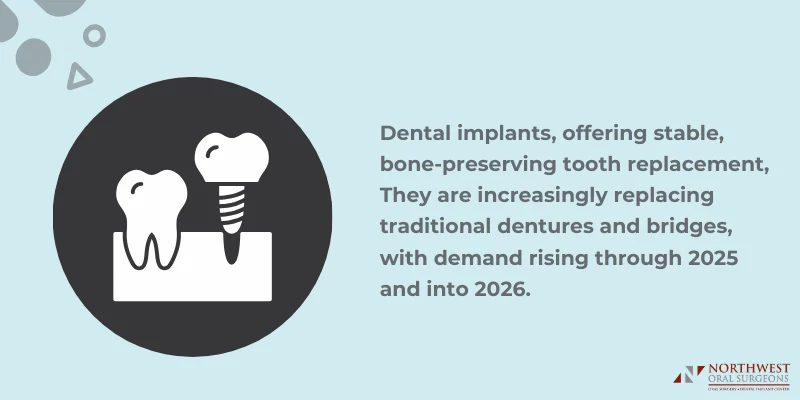
When teeth are lost, what next? Traditionally, the solutions for missing teeth were limited to removable dentures or fixed bridges. Over the past couple of decades, however, dental implants have revolutionized tooth replacement.
An implant is a titanium (or ceramic) post surgically placed in the jawbone to act as an artificial tooth root, which can support a crown, bridge, or denture. Implants offer superior stability and help preserve jaw bone health compared to conventional dentures.
As a result, demand for implants has been on a steady upswing from 2015 through 2025, and all signs point to even greater popularity heading into 2026.
National Implant Trends: The growth in dental implant procedures across the U.S. has been remarkable.
To quantify it, consider that around the year 2000, dental implants were relatively niche and costly, and many people with missing teeth didn’t even consider them. By the mid-2010s, implants had entered mainstream dentistry.
Statistics compiled by implant associations and market researchers estimate that approximately 3 million Americans have had at least one dental implant as of the mid-2020s. Each year, hundreds of thousands of new implants are placed.
In fact, it’s reported that over 2 million implant-supported crowns (individual replacement teeth on implants) are made annually in the U.S. now. That number has grown each year as more dentists get training in implantology and more patients become aware of the option.
Several factors are driving this trend:
- Aging Population: The baby boomer generation (those born ~1946-1964) is now largely in their 60s and 70s, prime ages for tooth loss issues but also a group that generally wants to remain active and healthy. Unlike prior generations who might have accepted full dentures as a fact of old age, boomers are often seeking better quality of life.
Many of them are choosing implants to replace lost teeth so they can chew comfortably and smile confidently. As this large population cohort ages, they contribute to higher demand for tooth replacement solutions. - High Prevalence of Tooth Loss: As we’ve outlined, despite improvements, there is still a huge population with missing teeth. Over 150 million Americans with at least one missing tooth translates to a massive potential market for implants. Not everyone will get an implant, of course, but even a fraction considering it means robust demand.
People who lose a single tooth in their 30s or 40s (perhaps due to a bad cavity or an accident) may especially opt for an implant to avoid cutting down neighboring teeth for a bridge. - Implant Awareness and Success Rates: Implants have a high success rate, and they are perceived as a long-lasting solution. Over the last decade, dental professionals and media have educated the public about implants.
It’s now common knowledge that an implant can effectively “permanently” replace a tooth. As stories of positive outcomes spread, more patients ask their dentists if they are candidates for implants.
The procedure, while involving surgery, has become routine for many oral surgeons and periodontists, with well-established protocols.
Healing times and techniques (like immediate load implants, 3D guided surgery, etc.) have improved, making the process more patient-friendly than in the early days. - Cosmetic and Functional Advantages: Implants address many drawbacks of removable dentures, no slippage, no need for adhesives, and the ability to bite with near-natural force.
For someone who has lost all lower teeth, for example, a common complaint is that a regular lower denture is hard to keep stable. Two implants to anchor a denture can be life-changing in that scenario.
Patients who can afford it often choose implant solutions (from single tooth to full-arch replacements) to regain a sense of normalcy. This preference has increased demand, especially among those who don’t want the stigma or inconvenience of dentures. - Market Forces: The dental implant market has been one of the fastest-growing segments in dentistry. By the numbers, the U.S. market for implants and related components was valued around $1.4 billion a few years ago and continues to grow annually at a healthy rate (estimated around 6–7% per year or more).
More general dentists have incorporated implant treatment into their services, and large dental service organizations (DSOs) heavily advertise implants. Competition and innovation have started to slightly reduce costs or at least offer more financing options, making implants accessible to a broader group than just the wealthy. All these factors create a positive feedback loop increasing uptake.
Implant Demand in Northwest Indiana: Given the high rates of tooth loss in NW Indiana, one might expect a correspondingly high demand for dental implants in that region. There is indeed strong interest, but it is moderated by economic factors. Here’s the local dynamic:
On one hand, Northwest Indiana has a large population of people missing teeth, whether it’s a middle-aged factory worker who lost a couple of molars over the years or a retiree in Gary who has been wearing dentures since age 60.
The need for replacements is substantial. Local dental practices note that inquiries about implants have risen as people hear that implants can stabilize a loose denture or replace that front tooth they’ve been missing.
Even in communities with financial challenges, many individuals truly desire the benefits of implants; they want to eat their favorite foods and not worry about dentures moving, and they want to feel confident about their smile.
On the other hand, cost and access are barriers that may temper the actual number of implants being placed in NW Indiana relative to the need. Implants are one of the more expensive dental procedures. A single implant and crown can cost anywhere from $3,000 to $5,000 (and that’s without considering if multiple implants or bone grafts are needed).
For someone without dental insurance or with insurance that doesn’t cover implants (many basic plans don’t, or they have low annual maximums), that price is prohibitive. In areas like Gary or Hammond, many residents simply cannot afford thousands of dollars per tooth.
Therefore, although they have a high prevalence of missing teeth, they might opt for more affordable solutions (like dentures or partial dentures) rather than implants.
We often see a gap where the demand (desire) for implants is high, but the realized demand (actually getting the procedure) is lower because of financial constraints.
However, there are indications of growth in implant services even in NW Indiana. Some clinics and oral surgeons in the region offer competitive pricing or payment plans to attract patients who need multiple implants.
There are also itinerant oral surgery centers and denture clinics that advertise implant-based “snap-in dentures” or full mouth implant solutions on payment plans, trying to cater to the large edentulous population.
As awareness grows that implants aren’t only for the rich and famous, more NW Indiana residents are at least consulting about them.
The proximity to Chicago (a major urban center with many specialist dentists) means some Hoosiers might travel across state lines for advanced implant procedures if not available or affordable locally.
Living in Northwest Indiana and exploring dental implant options? Contact us to schedule a consultation and learn which solutions may be right for you.
Historical Trends (2015–2025) and Outlook for 2026
Looking back over the last decade, the landscape of tooth loss and replacement has gradually improved in some ways, yet remained stubbornly problematic in others.
From 2015 to 2025, national survey data show small but meaningful declines in the prevalence of tooth loss among Americans. More children are cavity-free, more adults are keeping most of their teeth into old age, and the percentage of seniors with complete tooth loss has dropped.
These gains are attributable to better preventive dentistry (wider use of fluoride toothpaste, dental sealants for kids, etc.), increased public awareness of oral health, and perhaps a generational shift in attitudes (today’s seniors benefited from post-1950s dental advances).
However, the improvements have not been evenly distributed. Socioeconomic and regional disparities persist. Wealthier states and communities saw bigger improvements, while poorer areas lagged.
Indiana’s overall oral health metrics, for instance, did not improve as much as some states with stronger dental public health programs.
Within Indiana, Northwest Indiana’s challenges in the 2010s through mid-2020s remained acute despite some localized efforts (such as free dental clinic days or nonprofit community health centers expanding dental services).
Thus, while America as a whole is entering 2026 with better oral health than decades past, pockets like NW Indiana remind us that many people are still suffering from preventable tooth loss.
On the technology and treatment side, 2015–2025 was a period of remarkable growth in restorative options. Dental implants went from a somewhat elite solution to a fairly common procedure. Digital dentistry (like 3D imaging and CAD/CAM crowns) made tooth restorations more efficient.
These advances improved outcomes for those who could access care. A person who lost a tooth in 2025 had a better chance of getting a high-quality replacement (implant or otherwise) than someone who lost a tooth in 2005.
Looking forward, by 2026 we anticipate further adoption of such technologies. For example, more general dentists are expected to start offering simple implant placements in-office as training becomes widespread, which can increase access.
Projections for 2026 and the near future include a mix of optimism and caution:
- The overall rate of complete edentulism among seniors is expected to continue its slow decline. It may inch down another percentage point or two as younger cohorts (with better dental care in their youth) age into seniority.
That said, because the senior population is growing rapidly, the absolute number of edentulous individuals will likely remain high. In other words, fewer seniors proportionally will be toothless, but there will be more seniors in total, so denture and implant services will still be in high demand. - Partial tooth loss will remain common, but the severity (number of teeth lost per person) might lessen slightly with better preventive care. Younger adults in their 20s and 30s right now have, on average, experienced less tooth loss than their parents did at that age, thanks to fluoridated water and modern dentistry.
If that trend continues, the typical 50-year-old in 2026 might have lost fewer teeth than the typical 50-year-old in 2015. This bodes well long-term, but economic inequality could counteract it for many. - In places like Northwest Indiana, focused efforts could improve the situation by 2026 and beyond. For example, if community health centers increase dental outreach or if Indiana were to extend more adult Medicaid dental benefits, we could see more people retaining teeth.
Local health departments have recognized oral health as part of overall well-being (Gary’s poor dental stats are tied to its other health problems), so collaborative initiatives on smoking cessation, diabetes management, and nutrition will indirectly benefit oral health too.
However, meaningful change in those NW Indiana statistics may take time. It’s likely that by 2026, Lake County will still have higher-than-average tooth loss rates, but hopefully the trajectory will be downward rather than upward. - Dental implant demand in 2026 is projected to be at an all-time high. The American Academy of Implant Dentistry projects continued growth, and industry forecasts suggest the implant market will expand significantly through the latter 2020s.
We expect to see more than 3 million Americans with implants, possibly inching towards 4 million as procedures become even more routine. “All-on-4” full-mouth implant treatments (where an entire arch of teeth is supported by 4 implants) have gained popularity and could become a go-to solution for edentulous patients who can afford it, potentially reducing the number of traditional dentures in use. - Innovations may also influence demand: for instance, if researchers develop ways to regrow teeth or if implants become less expensive due to new materials or delivery models, that could be a game-changer.
In 2026 we don’t expect natural tooth regeneration yet, but there are efforts in tissue engineering that could bear fruit in future decades. For now, implants remain the closest thing to regaining a natural tooth, and thus demand will stay strong.
References:
- American College of Prosthodontists – Facts & Figures
- CDC – Oral Health
- CDC – Oral Health Surveillance Report
- PubMed – Multiple Chronic Diseases Associated With Tooth Loss Among the US Adult Population
- PubMed – Reasons for Tooth Removal in Adults: A Systematic Review
- PubMed – A study of the reasons for tooth extraction in a Canadian population sample
- CDC – Mean number of permanent teeth among dentate adults aged 65 years or older
- CDC – Tobacco Use and Oral Health Facts
- CDC – Percentage of adults aged 65 years or older who were edentulous
- ZipDo – Dental Implant Statistics
- Gitnux – Dental Implant Statistics
- IMARC – United States Dental Implants Market